
Table of Contents
Picture a kid who can juggle the ball, weave through cones, and hit a pass with either foot. Then the game starts, and suddenly they dribble into a crowd, overlook a teammate standing wide open, or stand there like they’re waiting for instructions when the other team wins the ball. Parents often find this confusing. Practice looked great, so what happened?
Usually it comes down to soccer IQ. Players need to understand what’s going on around them, guess what’s about to happen, and pick the right move. Drilling passes and dribbles over and over won’t build that on its own. Kids need room to think, try things, and make calls in situations that feel like real games.
If you’re looking at a Soccer Academy Mississauga program, pay attention to how it handles game awareness and decision-making, not just technique.
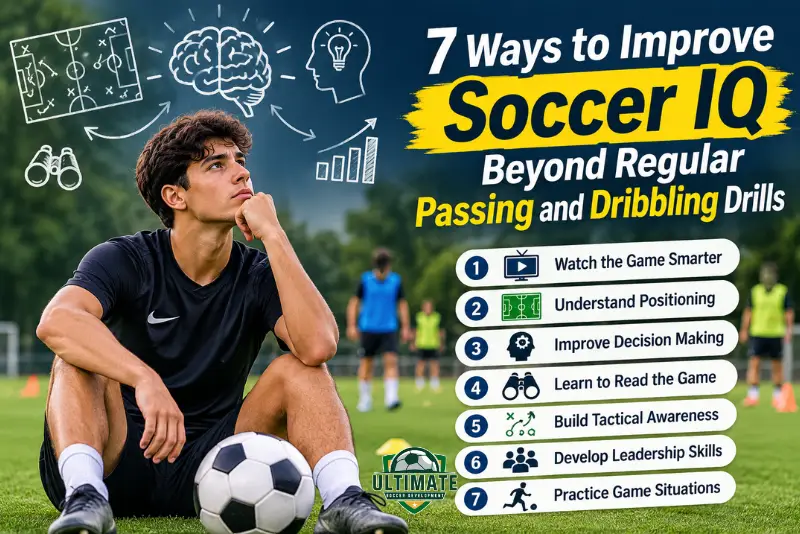
These are seven ways through which young soccer players can be made smarter, braver, and more intelligent in their game.
What Does Game Intelligence Look Like in Youth Soccer?
Game awareness means noticing what’s happening beyond the ball. A player with good soccer game awareness knows where teammates and opponents are, spots open space, and can tell when the team needs a hand.
It’s also about looking ahead. Say a midfielder sees an opponent charging in to press. Rather than waiting for that defender to arrive, the midfielder slips a pass to a teammate who has room to work with.
This connects to soccer tactical awareness. Players start to feel when it’s time to attack, when to defend, when to hold the ball, when to create space, and when to drop back.
Three abilities work together here:
Ability | What it looks like during a match |
Awareness | Noticing teammates, opponents, and open space |
Anticipation | Predicting what might happen next |
Decision-making | Choosing whether to pass, dribble, shoot, move, or defend |
Is Game Intelligence More Important Than Technical Skills?
They really go together. Technical ability allows a player to dribble, pass, shoot and control the ball. The game intelligence is the one that dictates when to execute those technical abilities.
The player may be an expert in dribbling, but what is required is to pass the ball to a teammate who is not marked by any opponent. Both skills and intelligence are required by the good players to execute the moves.
7 Ways to Develop Better Decision-Making on the Field
- Play Small-Sided Games Instead of Depending Only on Full Matches
In small-sided games, the ball gets into everyone’s possession more often. With fewer players, they always need to find space, communicate with each other, and attack and defend all the time.
The game can vary depending on the age of the players:
1v1: Deciding whether to attack, defend, or retain possession.
2v2: Passing the ball to the teammate and playing together.
3v3: Finding open space and creating passing options.
4v4: Understanding movement, positioning, and teamwork.
When playing three vs three, the player has a choice of passing, dribbling to the goal, or changing direction after being blocked by the other team from the lane.
Age-appropriate soccer drills for kids should keep children moving rather than standing in long lines.
- Practise Scanning Before Receiving the Ball
Some players check the field for teammates, opponents and open spaces prior to the arrival of the ball. This is referred to as “scanning” and it provides players with an idea of where they can go, who they can pass to, and what their next move will be.
Coaches can run simple soccer scanning drills with coloured cones. As a teammate passes, the player checks over their shoulder and calls out the colour or number the coach shouts before controlling the ball. Once they’re comfortable, add a defender.
The goal is for scanning to become automatic, not something kids only do when someone reminds them.
- Use Decision-Making Activities That Make Players Think
A standard passing drill tells a player where the ball should go. A game-based activity makes them work it out.
That’s why soccer decision making drills are so valuable. They hand players a problem to solve instead of a sequence to memorize.
Coaches can try three activities:
- 2v1 attacking: Two attackers face one defender. The player on the ball decides whether to pass or take the defender on.
- 3v2 attacking: Three players try to create a scoring chance against two defenders, spotting openings and choosing the right moment to pass or shoot.
- Rondo: Players keep possession while opponents try to win the ball. Everyone has to keep moving and look for options.
After each activity, the coach can ask, “What did you notice before you made that pass?” That gets kids talking through their thinking instead of just following orders.
- Teach Players to Move Without the Ball
A player doesn’t need the ball to help the team. Movement creates opportunity for all.
Developing an understanding of reading the game in soccer also includes understanding what one should do if the teammate is in possession of the ball. For example, a forward can move towards the corner to lure the defender out of the midfield. Or, a midfielder can take up open space to provide an additional option for his team member who possesses the ball.
Such concepts can be used by coaches while designing a possession game and reward the players with points if he moves towards the open space. That rewards useful movement, not just goals or flashy dribbles.
Players can ask themselves:
- Where can I move to help my teammate?
- Am I standing behind an opponent?
- Can I create space for someone else?
- Should I move closer to support the attack?
- Practise Attacking and Defending Transitions
Possession can flip in a second, so players have to switch from attack to defense without hesitating.
A Youth Soccer Clinic Mississauga can include simple transition drills to build these reactions:
- Split players into two teams for a small-sided game.
- When possession changes, the new attacking team tries to score.
- The other team has to recover fast and protect its goal.
These drills teach kids when to press, when to recover, and when to launch an attack.
- Let Young Players Try Different Positions
If a player always plays striker, he will understand attacking runs very well but won’t necessarily understand all the things that go on in the heads of defenders and midfielders.
By playing in various positions, children will gain a more holistic picture of the sport.
Position | What players need to recognize |
Defender | Movement of the opponent, space behind the defence, timing of challenge |
Midfielder | Passing opportunities, space, change in possession of the ball |
Forward | Defensive spaces, timing of run, shooting opportunity |
Winger | Space along the wing, timing of crossing and cutting in |
It is beneficial for players to explore different positions in order to understand their teammates better. Positional skills have to be introduced to players slowly and not prematurely constrain them into one position.
- Watch Soccer Games and Evaluate Decision Making
Soccer helps children learn how to position themselves. Instruct children to observe one player for some period of time rather than just chase the ball.
Players in Soccer Training Mississauga programs can also review match clips and think about their own choices:
- Did I look around before receiving the ball?
- Could I have moved into a better space?
- Did I notice an open teammate?
Reflecting like this helps players learn from mistakes and make better calls next game.
Help Your Child Build Better Game Awareness
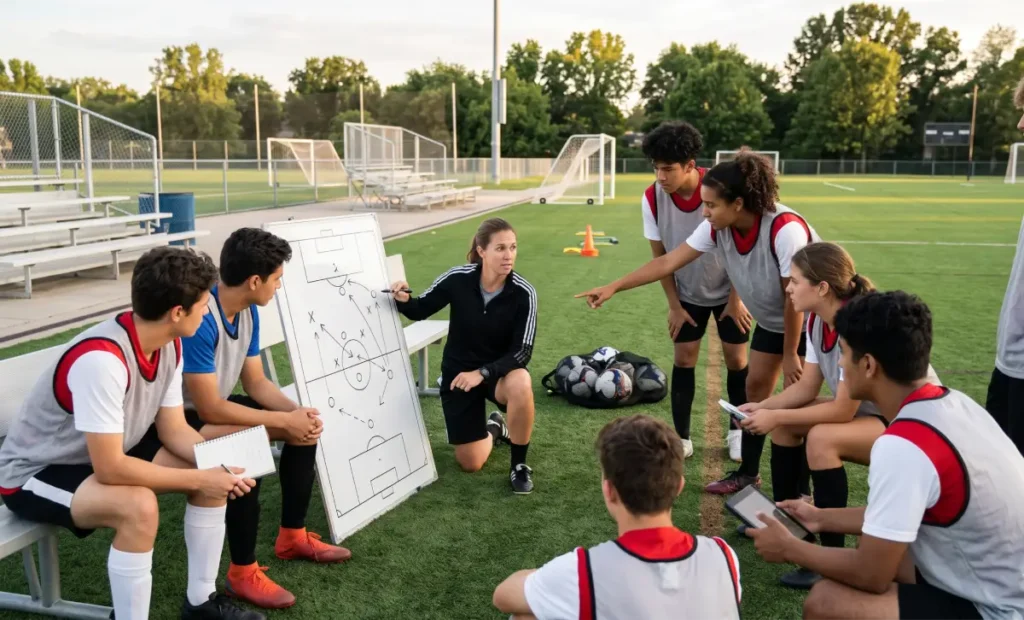
Do you need help developing your child’s soccer skills? The Ultimate Soccer Development Academy, coached by Coach Kyle, will provide game awareness, technical ability, and field confidence for your child.
Contact us at (647) 880-6121 or coachkyle@ultimatesoccerdevelopment.ca to explore training opportunities.
How Can Parents Support Their Child’s Development?
Parents do not have to take over the training in order to help. Often the best way is not on the training field.
- Promote free play. Unstructured games among friends allow children to explore and problem-solve without any set procedure.
- Watch games together. Choose a single player to observe and analyze their movements, positioning, and assistance to teammates.
- Ask more questions than give orders. Try “What other option did you have?” before telling your child what they should have done.
- Praise good decisions. Even a good pass or solid defense should be appreciated, whether or not a goal is scored as a result.
Such little things play an important part in helping youth soccer become more developed.
Choosing The Right Soccer Training in Mississauga
The choice of one or another training course is not only about comparison of costs and time slots. Observe the way coaches deal with the players, and pay attention if the practices have a balance of technical exercises with actual match conditions.
When choosing soccer training for kids Mississauga parents should take into account a few important things:
- How much time do children spend actively playing?
- Are small-sided games part of regular sessions?
- Do coaches explain positioning and movement?
- Are players encouraged to make their own decisions?
- Is feedback appropriate for the child’s age and ability?
It’s also worth looking at the coaching approach, how sessions are structured, and whether kids get to use what they learn in real game situations.
When Can Individual Training Help?
Group sessions teach teamwork and let players apply their skills in matches. However, some kids may require additional assistance in certain aspects of their play.
Individual training provides a lot of time spent working on such skills as ball control, receiving under pressure, scanning, positioning, and decision making. Individual coaching also enables players to focus on their problem areas.
In case you are thinking about hiring Private Soccer Coaching Mississauga, make sure that coaches combine technical drills with game situations. This way, the knowledge gained in individual training will be easily transferred to team training and matches.
Can Adults Improve Their Game Awareness as Well?
Certainly. Adults also have an opportunity to improve their positioning, anticipation, and decision making skills in recreational and competitive environments.
For those adults searching for Soccer Training for adults mississauga, there are training sessions that incorporate technical skills with game-related drills. This will enable them to feel comfortable making decisions under pressure.
The approach remains the same regardless of age, observing the environment, assessing your options, and making a sound choice based on that assessment.
What Does Canada’s 2026 Grassroots Approach Mean for Parents?
Canada Soccer’s Grassroots Standards for 2026 would be helpful while evaluating a youth program. The new standards were made mandatory by Canada Soccer for its members before the start of the 2026 playing season. The emphasis is on creating an age-specific environment for learning and participation.
The recommended match formats vary by age group:
Age group | Match format |
U4–U6 | Informal games |
U6–U7 | 3v3 |
U8–U9 | 4v4 without a goalkeeper or 5v5 with a goalkeeper |
U10–U11 | 7v7 |
U12–U13 | 9v9 |
These formats give young players more chances to get involved as they grow. Check if the local program is up to the relevant standards and provides a secure, fun environment with lots of actual participation.
Help Young Players Make Better Decisions
The key to building soccer IQ is about educating players how to understand the game and make decisions. Playing small-sided games, scanning and playing real games assist in the process.
Players that require personalized training can consider Private Soccer Training Mississauga at Ultimate Soccer Development Academy where Coach Kyle emphasizes technical skills, game awareness, and on-field confidence.
With the necessary guidance and practice, one can become more confident with their decision-making and have an in-depth understanding of the game.
Ready to support your child’s soccer development? Contact Ultimate Soccer Development Academy to explore training options. Call (647) 880-6121 or email Coachkyle@ultimatesoccerdevelopment.ca.
FAQs
Can players learn to make better decisions in soccer?
Yes, it is because of match experience, game-like training, and regular feedback.
At what age should one start developing game sense?
It is possible to develop game sense through playing at a relatively early age. One may start teaching more complex tactics depending on experience.
Are small-sided games better than usual technical drill?
No, both training methods have their role to play: while drills teach techniques, small-sided games teach to use them in the field.
How can I assess that my child is improving?
It is possible to do it by his/her better positioning, awareness, decision making and team assistance.
Does private training help with match performance?
Yes, it offers focused guidance. Players still need team practice and match experience to put those skills to work.